

Samsung Odyssey G7 32" Monitor Review
This is one of the most heavily requested monitor reviews nosotros've had in quite some time. Samsung has done well in creating hype effectually the Odyssey G7, and today the embargo has lifted for u.s.a. to publish this review fifty-fifty though the monitor has been on sale in some countries and we've had one in our labs for a few weeks now.
First, the spec canvas: the Samsung Odyssey G7 sports a 2560 x 1440 resolution, 240Hz refresh rate, VA console, 1000R curvature and even some DisplayHDR 600 functionality. No doubtfulness part of the anticipation comes from this next generation Samsung VA panel that can handle a 240Hz refresh charge per unit.

Nosotros've tested the 32-inch variant of the Odyssey G7 which sells for $800, slotting in the high finish of the 1400p gaming segment. A smaller 27-inch model is available for $700 and in that location's besides the $i,700 Odyssey G9, which is a massive ultrawide which we hope to review later on.
Blueprint
Samsung has done a practiced job on the design front end. The build quality is excellent, conforming of a loftier-end flagship production. While most of the outer surface is plastic, including the wide-pronged stand, it's a overnice high quality plastic with a solid matte finish.
The rear of the monitor features this unique pattern that draws attention to the center circle where the display is mounted to the stand. Here'south where you discover Samsung's "Infinity Core" lighting, which is just a fancy name for RGB LEDs that illuminate this expanse. There are also two small lighting zones on the front -- single RGB zones here, too -- honestly we could give or take the RGB elements, merely at least they're integrated well into the design.

The stand is moderately sturdy and has a proficient range of motility, including pinnacle, tilt, pivot and swivel aligning. The level of summit adjustment is quite decent for a large 32-inch panel, and you can utilize this monitor in a portrait orientation, too, if you want to utilise a curved monitor like that. It does back up VESA mounting as well.

The big elephant in the room is that curve: 1000R. This is almost, but non quite, twice every bit curved equally the more standard 1800R curve that's used past most other curved monitors. Fifty-fifty compared to some newer 1500R options, the 1000R curve is much more noticeable and obvious.


So the question is, practice I like the curve? Is 1000R the way frontwards for monitors? And the answer in my opinion is a resounding no. In fact, I hate this monitor'south curve, I'grand not a fan of an 1800R curve with a 16:9 aspect ratio display at the all-time of times, but 1000R is just ridiculous. Can't say who asked for this and ultimately we call back volition plough off more than buyers than it will attract.

We do take some specific reasons why we don't like this, coming after near a month of using the Odyssey G7. First is distortion, especially when viewing the 32-inch console at a normal viewing distance. If you move a flat paradigm across the display, information technology will noticeably warp as it passes from one side, through the middle, to the other side. Information technology's basically the exact opposite of lens distortion you might have seen with a fisheye or wide angle lens. It looks wrong. While my brain can usually compensate for that distortion on an 1800R panel, information technology's too overwhelming at 1000R, especially with desktop or productivity apps. This hurts the versatility of this monitor, so we don't recall it's a good dual-utilize monitor for gaming and creative piece of work, for example.

We volition say, nonetheless, that the obviousness of this distortion will depend on how shut y'all sit to the display. Normally, I sit ~60 to 80 cm away from my monitor (24 - 32 in). Only if I viewed the Odyssey G7 from upwards closer, the curve was far less noticeable and the feel was more immersive. Then again, I experience sitting as shut as twoscore cm (15 in) away from a monitor is besides close and would probably cause severe eye strain after prolonged apply. We besides thought the curve is something nosotros might get used to, but later nigh a calendar month we just haven't.
For ports, the Odyssey G7 includes two DisplayPort connectors and HDMI 2.0. Nosotros experience the lack of HDMI ii.1 is a bit of a miss. There'southward besides a 2-port USB hub and an audio output jack.


The OSD is controllable through a directional toggle along the bottom edge of the screen, very like shooting fish in a barrel to navigate though it'due south not the about feature-rich OSD experience. In that location are a option of color controls and picture show in motion picture modes, likewise equally a shadow boosting and cheat crosshair modes, but you're not getting as much functionality as the latest high-end monitors from Asus or Gigabyte.
Display Performance
Response Times / Overdrive Modes
Some other of the central questions going into this review was: can Samsung's latest VA panels actually deliver response times that are good enough for 240Hz gaming? Well, let's observe out, but there is an interesting note here first: you lot can't change the overdrive setting with adaptive sync enabled. So whether you use this with FreeSync on an AMD GPU, or G-Sync with an Nvidia GPU, overdrive controls are greyed out. This makes testing much more straightforward, merely tin can be prone to problems if that one overdrive selection isn't astonishing.
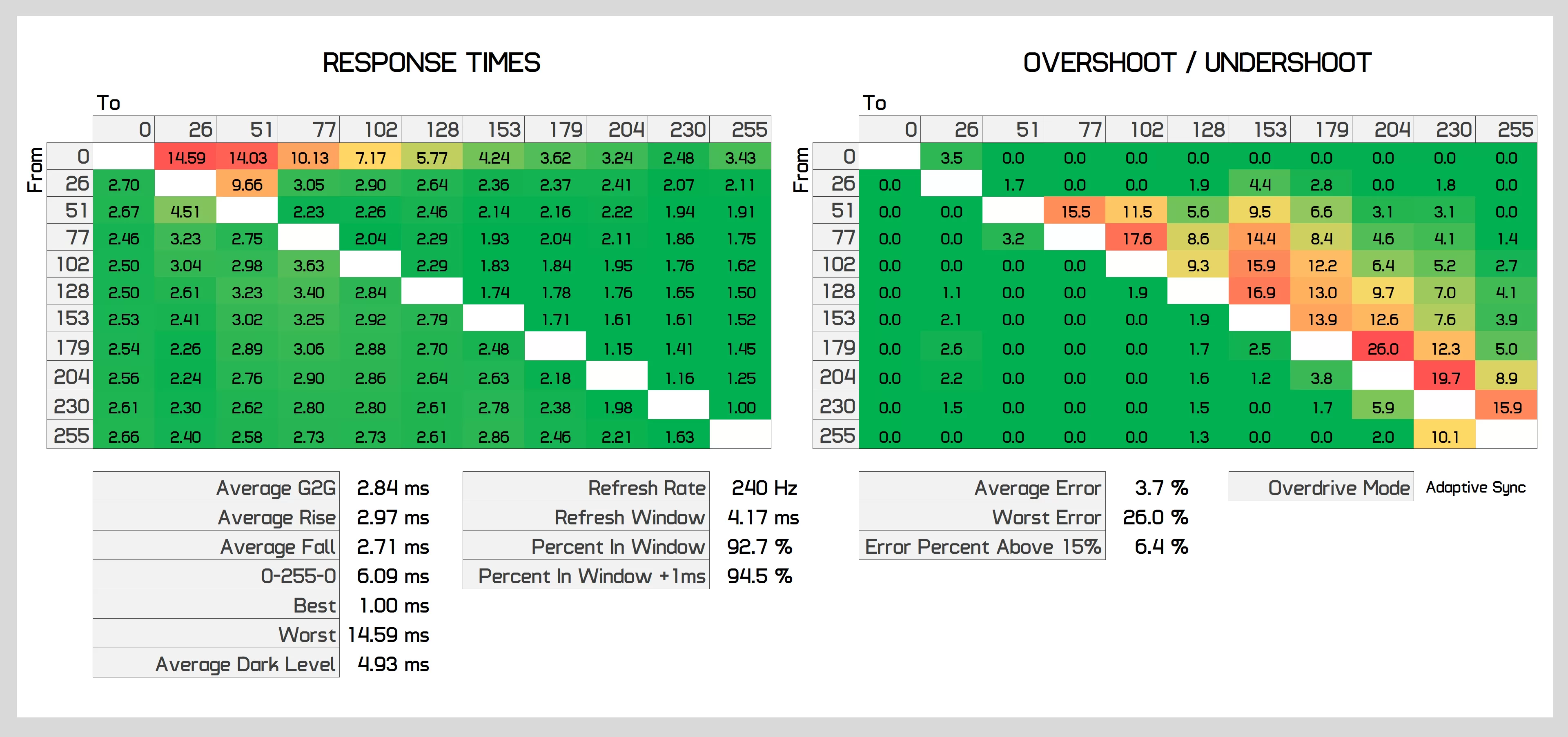
Luckily, at 240Hz the Odyssey G7 delivers astonishingly good response times. Not only good for VA response times, merely good for any monitor we've tested, including TN panels. What we're seeing hither is quite remarkable for a monitor engineering that has often been criticized for being wearisome and not suitable for gaming. You can throw that idea right out the window with the G7: Samsung'southward next-gen VA tech can compete with the large boys.
At 240Hz we see an average grey to greyness response time of 2.84ms, which means that more than 90% of transitions are truly fast enough for a 240Hz experience. Nosotros also see minimal overshoot. Yes, there'due south a flake creeping in for some sub-2ms transitions, only on the whole you lot get limited changed ghosting that we found hard to detect.
What'south too impressive is the amount of night level smearing. VAs typically have very slow transitions in the region up to around 102 or 128 gray, particularly when transitioning from full black. But that's non the case here. We should also say that this performance was captured after the monitor had warmed up for several hours to a nice steady state, VAs tin be much slower when they are first turned on and running "cold," so you might notice a bit more than trailing and ghosting in the beginning 30 to lx minutes of use. But in one case it's reached steady state, there's practically zero ghosting with this monitor at 240Hz, even for a lot of darker content.

What'southward fifty-fifty amend nearly the Odyssey G7, this sort of performance is largely held throughout the refresh range. When dipping to 200Hz nosotros saw the almost overshoot of whatsoever refresh charge per unit tested, but given the 2.5ms response time this isn't too bad and in do you don't run into much inverse ghosting.

At 165Hz, night level smearing is near entirely eliminated from the G7 while maintaining a 3ms response time with no overshoot. This continues through 144Hz and 120Hz. By the fourth dimension we're down at 100Hz, at that place is a bit more overshoot nowadays in the dark level area, only again, the Odyssey G7 maintains around that 3ms response. Then at 85Hz and 60Hz, nosotros fall to a 4ms response with a small amount of dark level smearing.
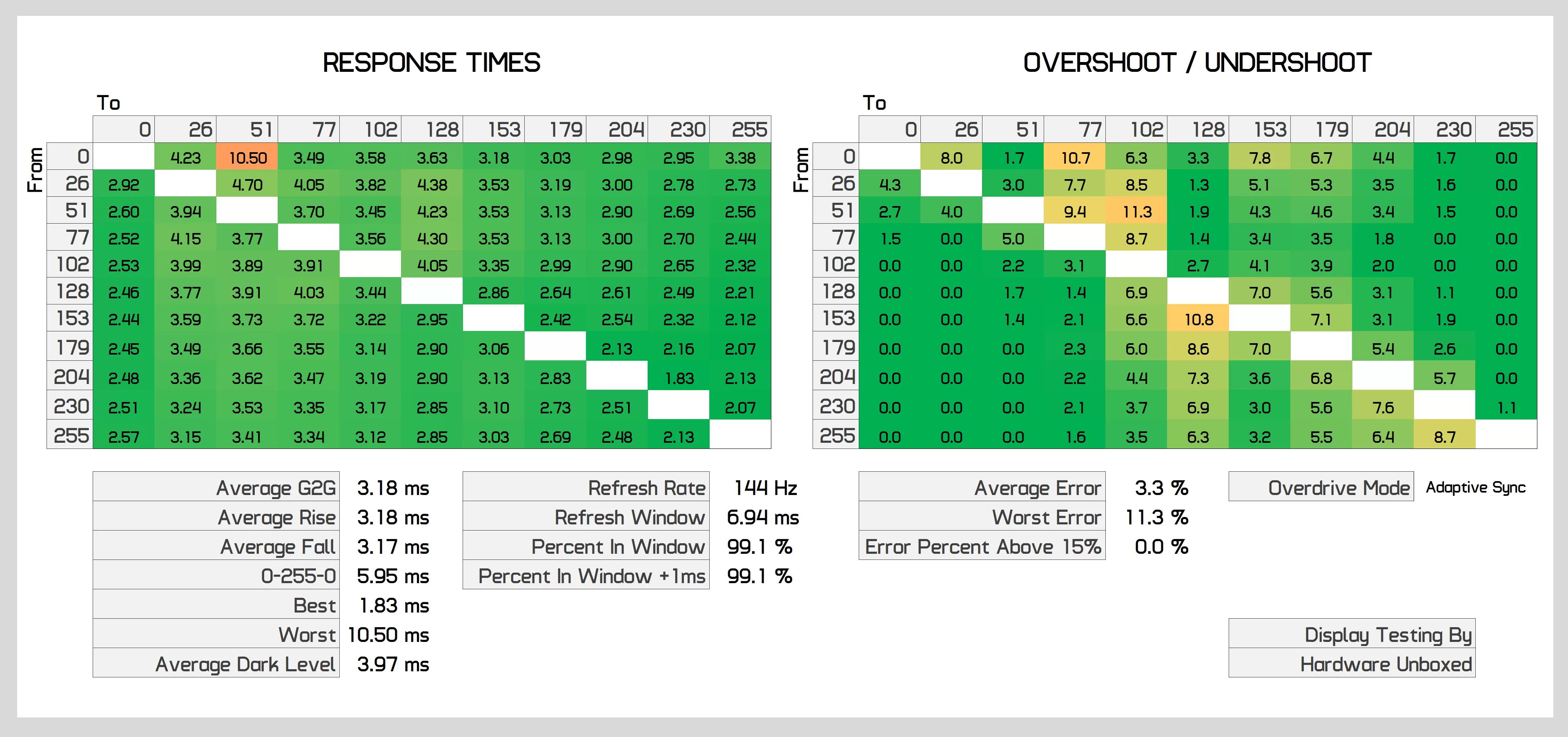


The of import matter to note is that at no point does this monitor require a different overdrive setting. Y'all tin't change the overdrive way with adaptive sync enabled anyway, simply there's no reason to. Samsung has tuned this display to perfection, delivering operation right on the edge of what the VA panel is capable of at all refresh rates tested. We're non certain whether they are using variable overdrive – they aren't using a Chiliad-Sync module – simply Samsung clearly know their own panel technology well and take paid special attending to dark level performance.
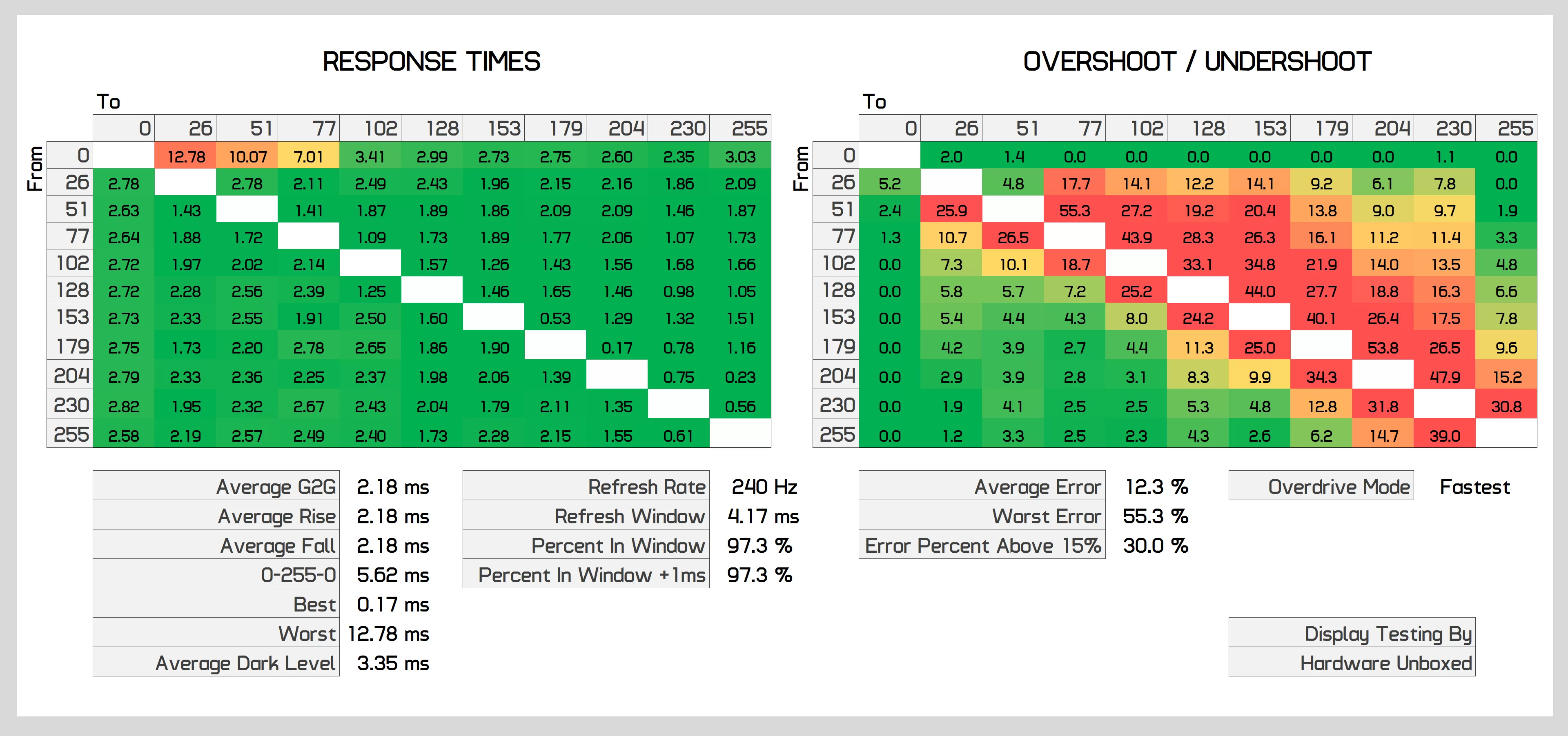
You tin can push the response times higher if y'all disable adaptive sync and switch to the "fastest" overdrive setting, however this introduces noticeable changed ghosting. Both the "standard" and "faster" modes appear identical and perform exactly similar the adaptive sync on results nosotros've just been showing.
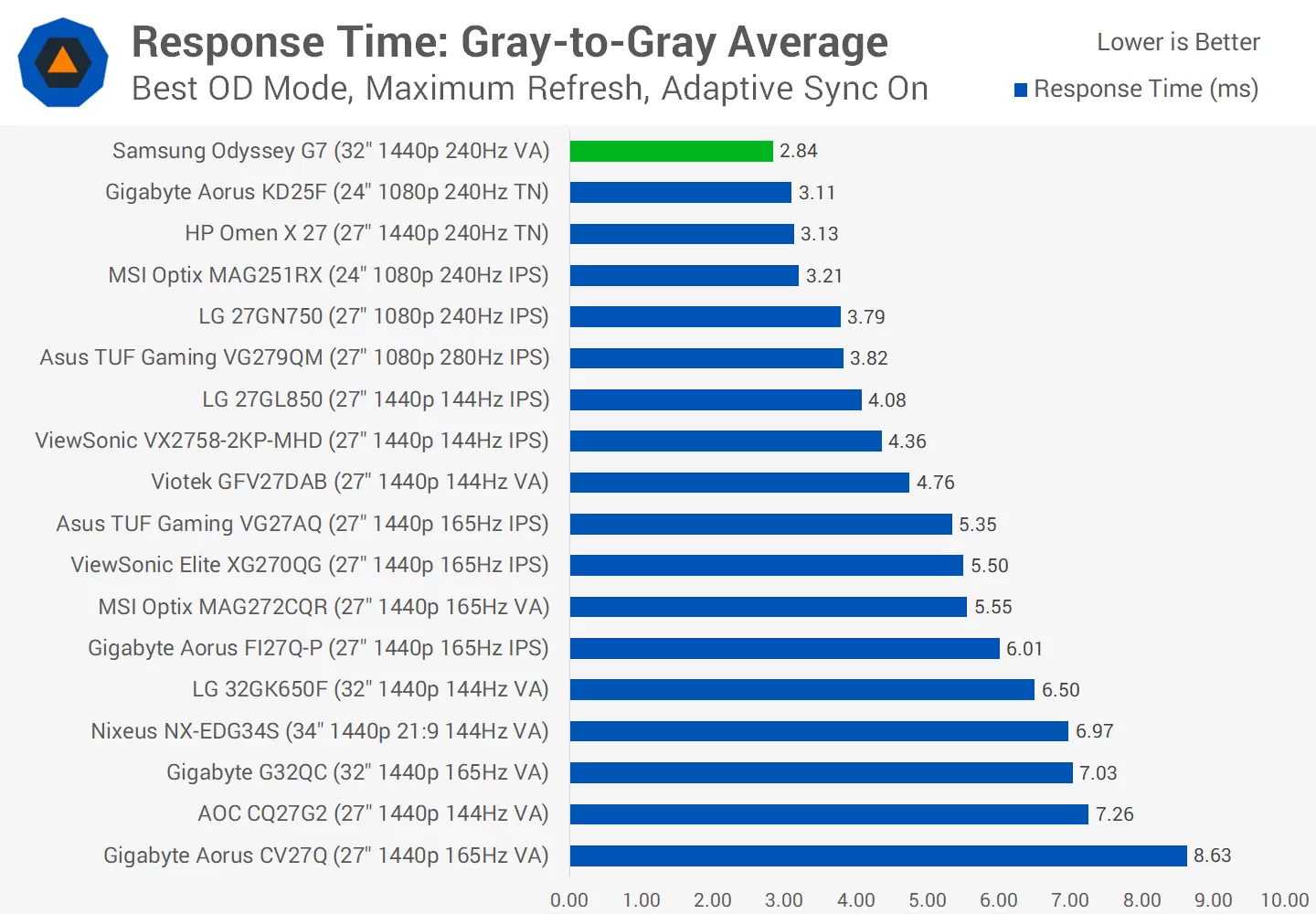
Compared to other monitors, the Odyssey G7 delivers elite performance. At 240Hz, this monitor delivers an average experience equivalent to the best TN displays on the marketplace, such every bit the HP Omen X 27 and the Gigabyte Aorus KD25F. It besides outperforms the all-time we've seen from IPS so far, including the "1ms" class tech used in the LG 27GL850 and LG 27GN750.
We should annotation that the outset 1440p 240Hz IPS panels are set to striking the market later this yr, which is going to exist a very interesting battle upward against the G7's VA.
We're as well seeing performance that far outstrippes the best VA monitors nosotros had tested before. Something like the Viotek GFV27DAB which all things considered has well tuned overdrive and uses a previous-gen Samsung VA panel, is nearly twice as slow. Then when you look at other options like the LG 32GK650F or AOC CQ27G2, it's a no contest, those VAs aren't remotely in the same class.

Night level functioning is good, but we practice see results that are more mid-tabular array, around the mark of a typical IPS brandish. TNs tin can hold the operation crown even so, then if y'all want zero dark level smearing of any kind, your best bet remains a 1440p 240Hz display like the Omen 10 27.

Looking at refresh rate compliance, we thought there was a loftier chance the Odyssey G7 wouldn't be fast plenty for a true 240Hz feel, but were totally wrong on that front. Over 90% compliance is excellent and what you're left with is a low motion blur, low smearing 240Hz panel.
Average error rates are mid table, indicating Samsung are pushing the G7 to its limits without going overboard, this tin can exist a tricky fine line to residual and Samsung announced to have navigated this challenge with precision.

At 60Hz, the Odyssey G7 is yet impressive with its 4ms average response time, but non quite equally fast equally the HP Omen Ten 27 which maintains a 3ms response time throughout the entire refresh range with no dark level smearing.
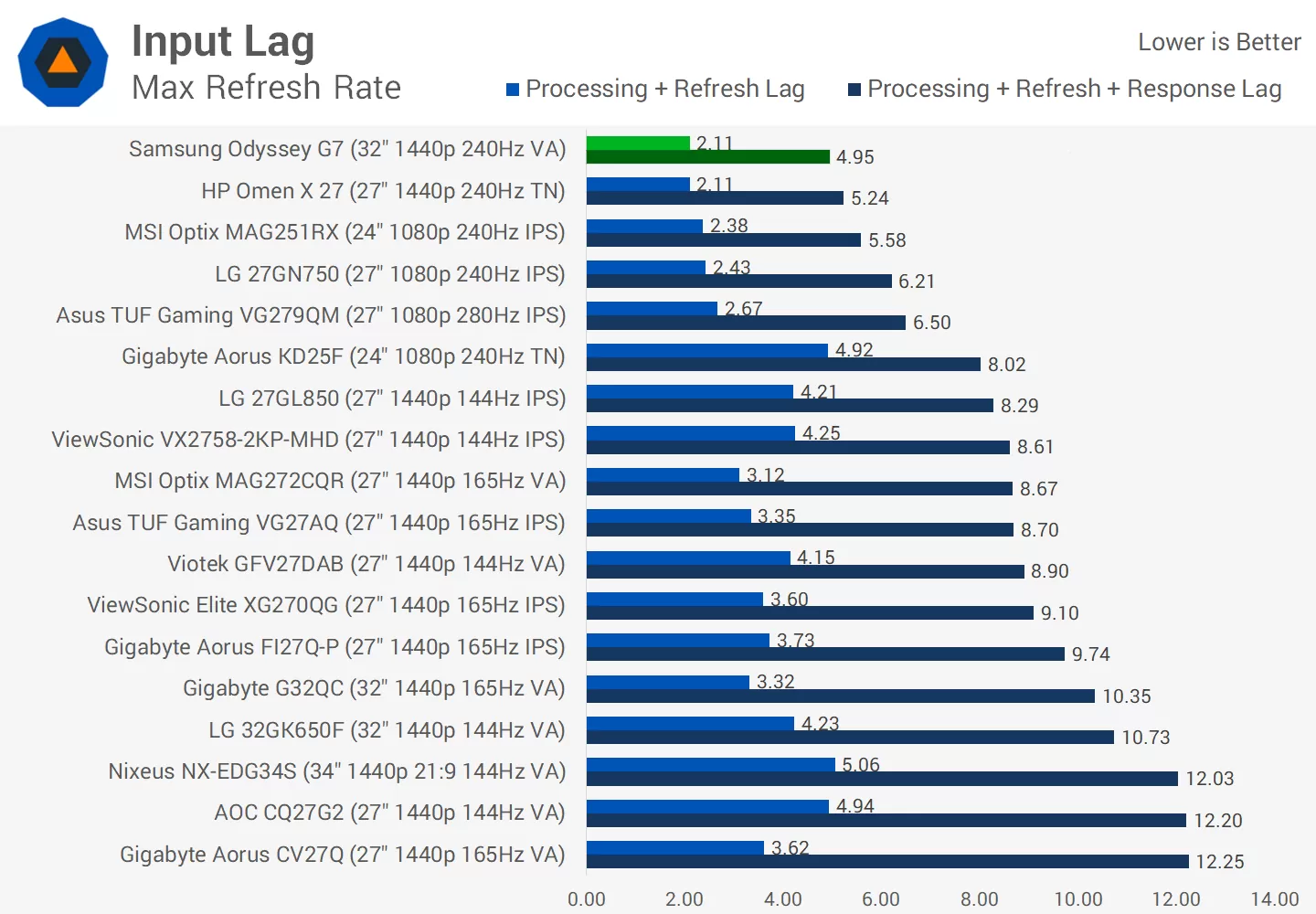
Input latency is a not event with this brandish, producing results that are in line with the Omen X 27 and faster than some other 240Hz+ displays we've tested. This is a highly responsive monitor in all regards, which is perfect for competitive gaming.
You might be thinking, surely with such fast response times, having a functional backlight strobing style is an absolute no brainer, this should be the perfect display for reducing motion blur in that way! Unfortunately, we're let down here by Samsung's implementation, which doesn't perfectly time the strobe with the refresh, and in that location's no mode to tweak said timing.
The terminate issue is that only almost 30% of the display had acceptable blur reduction, and this was in the lower third of the monitor. It's not unusual for the backlight strobe to be more than effective in some areas than others, but the heart of our unit as well as the unabridged upper one-half had noticeable double images at 240Hz. Overall this looked worse than having MBR disabled given the strong response times at 240Hz, and of form without being able to utilise adaptive sync and MBR at the same time, actually running games at the required 240Hz for this style might be a challenge.

Meanwhile, at lower refresh rates like 144Hz or 120Hz, the entire screen was plagued with double images and there was meaning changed ghosting to boot given the MBR mode also cranks upwards the overdrive setting to "fastest". So we wouldn't recommend this manner at lower refreshes.

The ane expanse where the Odyssey G7 is noticeably worse than the competition is power consumption. To achieve this level of performance, the G7 sucks down over 50W of power, which is ~70% higher than a typical 32-inch 1440p display at the same effulgence level. This is without the monitor'southward RGB lighting enabled, too.
Color Performance
Colour Infinite: Samsung Odyssey G7 32" - D65-P3
Now nosotros know response time performance is best-in-class from the Odyssey G7, just how does information technology fare for color reproduction? This is a broad gamut monitor, in our testing roofing 89% of the P3 gamut. This is around the same coverage every bit many other wide gamut VAs, and so at that place's been no progress on this front. IPS monitors similar the LG 27GL850 all the same go much closer to full P3 reproduction with 95 to 96% coverage in our testing.

Default Color Performance

Samsung are manufactory calibrating each Odyssey G7, and you lot can view the calibration results in the monitor itself. While Samsung does accept a large deltaE tolerance of five.0 for calibration – this should be iii.0 or ideally two.0 – my monitor did pass with a sub 2.0 deltaE, according to Samsung. But how did it fare in my tests?

Great, just non astonishing. A greyscale deltaE 2000 average of 1.91 is respectable and above average for a gaming grade brandish, and there was no noticeable tint with the retail unit Samsung sent. However the gamma is a flake off, especially on the depression end. What yous see below 30% grey is too high of a gamma past default, and what this ways is dark shades can be darker than they should exist. For gamers this might make dark environments harder to spot enemies in, and for accurateness purists well, it's not quite accurate.

Saturation operation is okay just the monitor does suffer from non having any sRGB clamp by default, the age old effect we see with broad gamut displays. This ways that without whatsoever further tweaking, the Odyssey G7 will oversaturate standard sRGB images. Similar situation with ColorChecker, a deltaE average of 16.46 is not great.

How did Samsung get a sub 2.0 deltaE boilerplate for this monitor at the manufactory? It'southward not specified, but nosotros believe they would take tested against P3, where I saw a default ColorChecker deltaE 2000 average of ane.95. Not too far off the 1.89 listed in the OSD.
OSD Tweaked Color Performance
As for OSD tweaks to meliorate color functioning, in our stance in that location are some strange choices made by default. For instance, we believe the default sharpness setting of 60 is slightly oversharpening the display, effectively post processing the image. Dropping that down to 56 removed some light haloing. Dynamic effulgence is too enabled by default, although for the tests you just saw that was disabled as it messes with the results.
The strangest 1 was the Black Equalizer set to 13 by default. We believe this setting is the crusade of that too-high gamma nosotros saw before for night shades. It does brand the brandish 'pop' as darks are darker, but it'southward not accurate, turning that back to 10 or 9 delivers the best results in terms of proper gamma performance.
On elevation of this, the Odyssey G7 includes an sRGB mode but it'due south functionally useless as it doesn't clench the display to an sRGB gamut. That'south disappointing when other high end broad gamut monitors exercise have proper sRGB modes.

Back to OSD tweaked performance, yous can meet that specially by irresolute that Black Equalizer setting, nosotros get much better gamma performance and superior deltaEs, if you think the monitor is as well dark out of the box, this might be the setting to alter. Outside of greyscale these settings merely accept a minor impact to performance.


Calibrated Color Operation
Finally, our full calibration results after a laissez passer through DisplayCAL. Excellent sRGB performance thanks to like shooting fish in a barrel 100% coverage, and a nice adherence to the sRGB gamma bend. We end upwards with deltaE ITPs around 2.0 and deltaE 2000s below 1.0 which is an first-class effect.


Calibrated P3 performance is also strong with the exception of elevation-terminate colors as the brandish delivers just 89% coverage of the P3 colour infinite. If you really need an accurate monitor for P3 work, we'd recommend choosing an IPS instead.

Brightness, at least in the SDR way, is decent at around 360 nits afterward calibration. Although you can't only get the display to run at 600 nits all the fourth dimension despite supporting that for DisplayHDR 600 reasons. Minimum brightness of 71 nits is on the higher end though.

The native contrast ratio of this console is disappointing in our opinion, at just 2000:1. This is on the lower end for a VA brandish, the better ones can exceed a 3000:i ratio. This is much higher than say, a 27GL850 – we're looking at a contrast ratio 3x as high – but relative to some of the better IPS offerings, black levels are less than twice as good.
Viewing angles are fine, like to other VA panels but of grade due to the aggressive 1000R curve this isn't a monitor you'll want to view at any angle other than dead straight on.


The nearly disappointing aspect to colour performance is uniformity. Not necessarily full white uniformity, which is fine, but more darker shade uniformity similar we saw from this xxx% grey reading. The edges of this display are peculiarly inaccurate and that'due south caused by noticeable backlight bleed, which presents for greys like this as a brighter vignette around the edges.


The backlight bleed is arguably worse for blacks, where we could notice the drain under reasonably brilliant lighting which is not good. And in a night room, the bottom edge of this monitor virtually has an IPS glow-like advent. VAs tend to exist decent in this regard, and then the Odyssey G7 is a significant outlier and we suspect most people who cease upward with a unit of measurement like mine will exist able to find this bleed.

Equally for HDR performance, we program to get in-depth on HDR testing later on, just for this review nosotros'll stick to the checklist, which reveals semi-HDR performance. We do get a peak brightness of 600 nits and around ninety% coverage of P3 so we do become two of the iii pillars of HDR. As the native contrast for the panel is low at around 2000:one, to become the proper contrast required for HDR content, we demand local dimming.
Samsung has used an entry-level local dimming implementation with merely 8 edge lit zones. This tin can aid deliver a college contrast ratio in some situations, just its usefulness is limited, hence why we label these monitors as "semi-HDR". The feel you get here is far from the best HDR monitors with FALD backlights, it'due south a niggling flake better than SDR, just it's not a key selling point in our stance.
What'south to Similar?
The Samsung Odyssey G7 does some stuff really well. Better than most any other monitor on the market, but it'southward certainly not perfect. Samsung absolutely nailed the Odyssey G7's response time operation. This display delivers elite response times, nearly equivalent to a modern TN panel and exceeding the fastest IPS displays nosotros've tested.
When paired with a top stop 240Hz refresh rate, we get a remarkably articulate prototype, complimentary of ghosting and smearing. Even night level operation is decent, a notorious downside of VA panels that has turned away prospective buyers for years. On top of that, this operation is seen across the unabridged refresh range with no need for overdrive adjustments, all without significant overshoot.

Given this TN-like response time, experience is paired with double the contrast ratio, better viewing angles, a wide gamut experience and a fleck of semi-HDR on meridian. We'd say that overall the G7 is a better choice than a TN equivalent like the HP Omen 10 27, even if the Omen is slightly faster and also cheaper.
Other good stuff includes the monitor'due south build quality, stand up, effulgence and fifty-fifty some aspects to mill calibration. Nosotros're non sold on the HDR functionality, but at least the feel is somewhat better than a regular SDR displays that get HDR 400 slapped on the box.

Now, put in proper context, this is still a high-end gaming monitor with a $700 request price for the 27-inch version and $800 for the 32-inch model nosotros've tested. At that toll point, the Odyssey G7 is at to the lowest degree $200 more expensive than our previous 27" 1440p recommendation, the excellent LG 27GL850, while the 32-inch is basically the most expensive 1440p monitor on the market overall.
Samsung has delivered amazing response times simply in other areas you're non getting the same treatment. For example, our review unit had too much backlight bleed and poor grey uniformity, which noticeably hurts image quality and is a regression compared to other VAs. The contrast ratio is also average for a VA, especially when displays with well over 3000:1 ratios are now bachelor.
Samsung also made some strange choices with their factory calibration options, including post-processing the display, darkening blacks and including a sRGB mode that doesn't clamp to sRGB. At $800, nosotros're not expecting professional person-class calibration, but we think it'southward fair to expect at least a proper sRGB mode. We'd also await HDMI ii.i for futurity proofing and a better backlight strobing mode.
Then is the curve. In our stance, this is a step in the wrong direction. While we always adopt flat panels, there would have been no complaints had they stuck to an 1800R curve. 1000R is going too far, although Samsung is promoting this as a feature.

If this monitor was apartment, we could exist looking at a highly versatile monitor, with wide appeal for gamers and the power to double as a solid creator monitor with a better-than-IPS contrast ratio, limited nighttime level smearing, and 90% P3 coverage. That dual use potential would significantly increment the value proposition of the Odyssey.
The 1000R curve and the distortion information technology introduces shuts off the Odyssey G7 from the productivity/creator market and shuts itself off from the portion of gamers that dislike curved monitors. The 1000R curve could be game-irresolute on the super ultrawide Odyssey G9, but on the regular xvi:9 G7, it's a bit of a miss.

That's not to say the Odyssey G7 is a bad monitor. If response times are your simply business organization – y'all want the fastest experience out there and not TN-level bad colors – and so the Odyssey G7 is absolutely the monitor you should choose. But flagship products with premium price tags lead to high expectations, and when considering the overall package we don't think the performance is quite there for a $700 or $800 product.
Moreover, competition is nearly to get really hot in the coming months. LG is set to introduce the 27GN950 at $700, which is a 4K 144Hz IPS monitor with DisplayHDR 600. We're also expecting the commencement 1440p 240Hz IPS displays to slot in around the $600 mark. Of class, nosotros oasis't tested those displays yet, but people interested in a loftier-end monitor might do good from waiting. We might get that more than versatile, or improve performing option.
Bottom line, Samsung has done fantastic things with this next generation VA panel engineering science, even if the Odyssey G7 doesn't striking all the correct marks. VA is absolutely dorsum as a contender for high-end gaming displays and nosotros're excited to see where this goes.
Shopping Shortcuts:
- Samsung Odyssey G7 32" on Samsung, Amazon
- HP Omen X 27 on HP Store, Amazon
- LG 27GL850 on Amazon
- Asus TUF Gaming VG279QM on Amazon
- GeForce RTX 2070 Super on Amazon
- GeForce RTX 2060 Super on Amazon

Source: https://www.techspot.com/review/2059-samsung-odyssey-g7/
Posted by: burgeandraideve.blogspot.com
0 Response to "Samsung Odyssey G7 32" Monitor Review"
Post a Comment